In 2026, businesses need more than traditional software to manage daily operations. As organizations handle increasing amounts of data, customer demands, inventory, financial transactions, and workforce activities, managing everything through disconnected systems can slow down productivity and decision-making. This is where AI-powered ERP automation is becoming an important part of modern business management.
Enterprise Resource Planning (ERP) software consolidates critical business functions into a centralized system. In contrast, Artificial Intelligence (AI) adds capabilities that enable businesses to analyze data, identify patterns, automate repetitive tasks, and make more informed decisions. When these technologies work together, firms may increase operational insight, minimize human burdens, and create more integrated workflows.
Combining ERP software with AI-powered automation allows expanding firms to boost efficiency in finance, sales, inventory, procurement, human resources, manufacturing, and customer management. Businesses can achieve a more intelligent and scalable operating model by implementing integrated ERP systems, custom software development, and AI application development.
What Is AI-Powered ERP Automation?
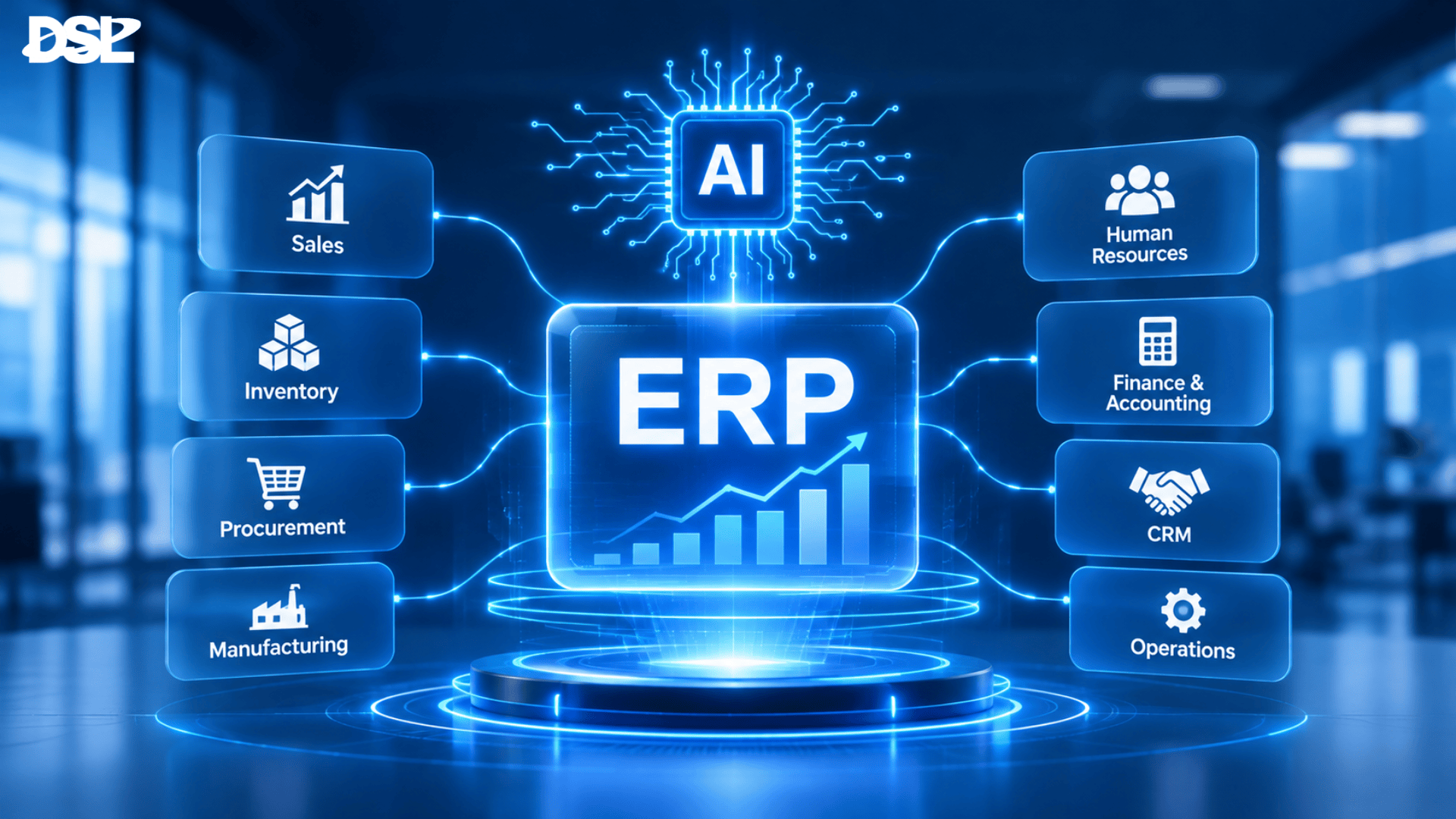
AI-powered ERP automation integrates Enterprise Resource Planning (ERP) software with artificial intelligence to improve how companies manage information, processes, and day-to-day operations.
Traditional ERP systems connect departments using shared data and defined workflows. They let organizations handle accounting, inventory, procurement, sales, human resources, manufacturing, and other operational processes through a consolidated platform.
AI provides an additional layer of intelligence to these systems. Depending on the application, AI can analyze corporate data, identify patterns, generate insights, aid in forecasting, process documents, and support automated workflows.
For example, an ERP system can track inventory movements and sales transactions. An AI-enabled process can analyze historical sales patterns to identify products that may need replacement. Managers can utilize this information to make better purchasing decisions.
Essentially, ERP integrates corporate activities, automation reduces repetitive work, and AI aids in the transformation of business data into meaningful insights.
Why Are Businesses Integrating AI and ERP in 2026?
To compete today, organizations want reliable information and efficient procedures. However, many firms continue to rely on spreadsheets, different programs, manual reporting, and fragmented departmental systems.
These constraints can present several operating issues.
Repeated data entry across multiple departments.
Delays in accessing critical business information.
It is difficult to track inventory and procurement activity.
Manual financial reporting and approval procedures.
There is limited visibility into employee and departmental performance.
Inconsistent customer data across sales channels.
Difficulties in detecting operational issues early.
7 Ways AI-Powered ERP Automation Improves Business Operations

1. Automates repetitive business workflows.
One of the most significant advantages of ERP automation is the reduction of repetitive manual tasks.
Many business processes require several phases, such as data entry, document preparation, approvals, alerts, and record modifications. When employees complete these tasks manually, they spend important time on administrative tasks rather than focusing on strategic objectives.
ERP software can automate organized workflows, including:
Creating purchase orders and routing them for approval.
Processing sales orders.
Managing invoices and payment records.
Employee attendance and leave workflows.
Inventory updates and stock movement reports.
Task assignments and internal alerts.
Routine operational reporting.
AI can enhance these workflows with features like document information extraction, intelligent classification, and automated request management.
For example, an AI-enabled document processing workflow can extract key information from an invoice and prepare it for verification within a suitable financial process. Employees can evaluate the information before final approval or posting.
This combination allows companies to increase workflow consistency while leaving key decisions under human control.
2. Enhances Inventory Management and Demand Planning
Inventory management is an essential component of retail, manufacturing, trade, and distribution operations. Poor inventory visibility can lead to overstocking, product shortages, delayed delivery, and excessive operating expenditures.
An integrated ERP system enables firms to manage inventory levels, product movements, warehouse activity, purchase orders, and supplier information from a single platform.
AI can help with inventory planning by analyzing historical sales, seasonal patterns, purchase trends, and other relevant company data.
For example, an AI-powered inventory analysis process can:
Identify products with a growing demand.
Highlight the most frequently purchased products.
Detect unusual inventory movements.
Assist with estimating future stock requirements.
Identify potential overstocking or shortage risks.
Promote more informed procurement planning.
These insights enable inventory managers to make better purchasing and replacement decisions.
For companies with several warehouses or distribution centers, combining ERP-based inventory management with intelligence analysis can boost operational visibility.
3. Improves financial management and reporting.
Financial management is more than just recording transactions. Businesses require precise financial data to monitor spending, manage budgets, measure cash flow, and assess overall performance.
ERP software integrates financial operations with sales, purchasing, inventory, payroll, and other divisions. This avoids information gaps and allows financial teams to operate from more consistent records.
AI-powered financial automation can offer additional assistance through:
Invoice and financial document processing.
Transaction categorization aid.
Unusual transaction identification.
Expense pattern analysis.
Cash flow forecasting assistance.
Automated report summaries.
Financial Trend Analysis.
For example, AI can examine previous revenue and spending data to find trends that may influence future financial planning.
However, AI-generated financial insights should be compared to validated accounting records and corporate policies. Financial approvals, compliance decisions, and critical accounting activities should be subject to suitable controls.
Organizations can enhance reporting efficiency and acquire a better understanding of their financial status by combining ERP financial management and intelligent analysis.
4. Improves sales and customer relationship management.
Sales teams require accurate customer information, fast follow-ups, and visibility throughout the sales process.
Tracking leads and managing connections becomes challenging when customer records are distributed across spreadsheets, email exchanges, and many programs.
An ERP-integrated Customer Relationship Management (CRM) system assists firms in organizing client data, sales opportunities, quotations, orders, and communication history.
AI can enhance sales and CRM activities by:
Providing classification and qualification support.
Customer behavior analysis.
Automated follow-up ideas.
Identifying sales trends.
Handling customer inquiries.
Personalized communication assistance.
Sales performance insights.
For example, an AI-powered CRM process can evaluate client inquiries and assist sales professionals in prioritizing prospective opportunities based on established business criteria.
When CRM information is connected to ERP data, sales teams can acquire a better understanding of order status, product availability, and customer transactions.
This offers a more integrated sales process and enables organizations to provide a uniform client experience.
5. Improves human resource management efficiency
Human resource management includes a variety of interconnected operations like as recruitment, personnel records, attendance, leave management, payroll, performance evaluation, and workforce planning.
Managing these activities through disparate platforms can increase administrative burden and make it harder to track personnel information.
An integrated ERP or HR management system centralizes workforce information and assists HR staff in managing critical employee functions.
AI-powered HR automation can support specific procedures, such as:
Assisting with screening recruitment documents.
Employee data management.
Attendance and workforce trend analysis.
HR report preparation.
Employee inquiry help.
Workforce planning insights.
Performance data summarization.
For example, an AI-powered HR assistant can assist staff in locating information on leave regulations, attendance procedures, or internal HR guidelines.
However, critical HR decisions such as recruiting, performance appraisal, and employee assessments necessitate adequate human oversight, transparency, and data protection.
Combining HR management software with ethical AI capabilities enables firms to minimize administrative duties while improving workforce management.
6. Enhances manufacturing and supply chain operations.
Manufacturing companies handle complicated workflows that include raw materials, production schedules, work orders, quality control, finished goods, and distribution.
Coordinating these processes without an integrated system can be difficult, especially when production and inventory data are kept separate.
ERP software integrates industrial activities with procurement, inventory, sales, and financial administration.
AI can provide value by evaluating manufacturing and operational data to support:
Production planning and scheduling.
Material requirements analysis.
Quality trend identification.
Equipment maintenance planning.
Identifying supply chain risks.
Monitoring production performance.
Demand and resource forecasting.
For example, a manufacturing organization can use ERP data to track raw material availability and production schedules. AI-powered analysis can aid in detecting future material shortages or atypical production patterns.
This enables managers to explore operational issues earlier and make better decisions.
When implemented in accordance with actual production requirements, integrated ERP and AI capabilities can help to organize manufacturing and supply chain management.
7. Enables real-time business intelligence and decision-making.
Business leaders require precise data to analyze performance and find areas for development.
Employees must frequently manually collect information from many departments, compile spreadsheets, and generate reports under traditional reporting methods. This procedure has the potential to delay key decisions.
ERP systems centralize business data and deliver dashboards, reports, and analytics across multiple operational domains.
AI-powered analytics can enhance decision-making by:
Identifying trends in business performance.
Summarizing enormous amounts of operational data.
Highlighting anomalous changes in important metrics.
Supporting revenue and demand forecasts.
Comparing performance across departments.
Creating natural-language explanations for selected reports.
For example, management can examine sales, inventory, procurement, and financial data together to better understand how various operational activities affect corporate success.
The result is a more integrated approach to corporate intelligence, allowing decision-makers to obtain relevant information and explore challenges more effectively.
Traditional ERP vs. AI-Powered ERP Automation
Traditional ERP and AI-powered ERP automation have the same underlying principle: linking business processes and centralizing operational data. The distinction is in how intelligent capabilities may expand the system.
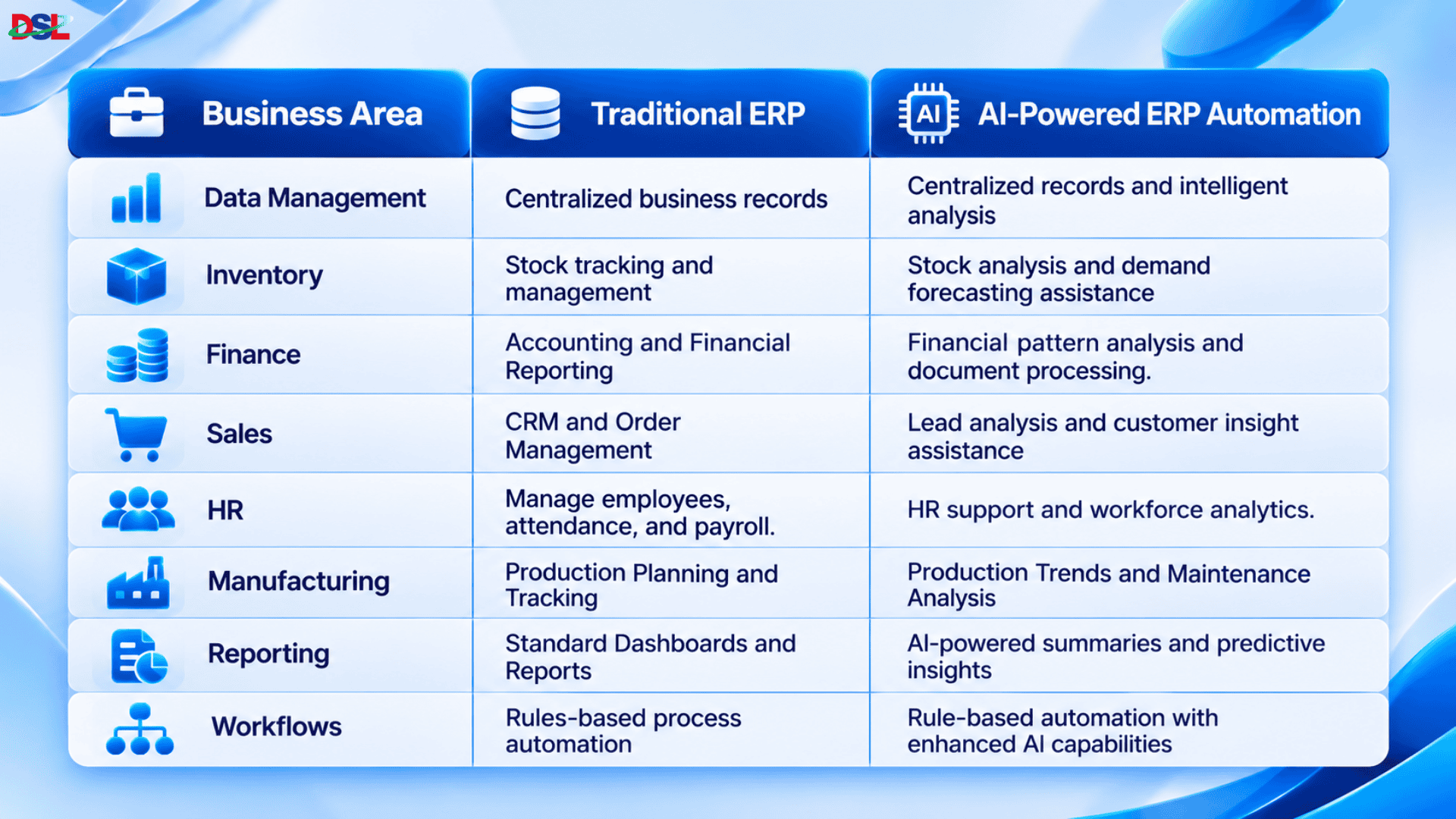
The most appropriate solution is determined by an organization's business requirements, available data, integration capabilities, and desired level of automation.
The Importance of Custom ERP Software for Modern Companies
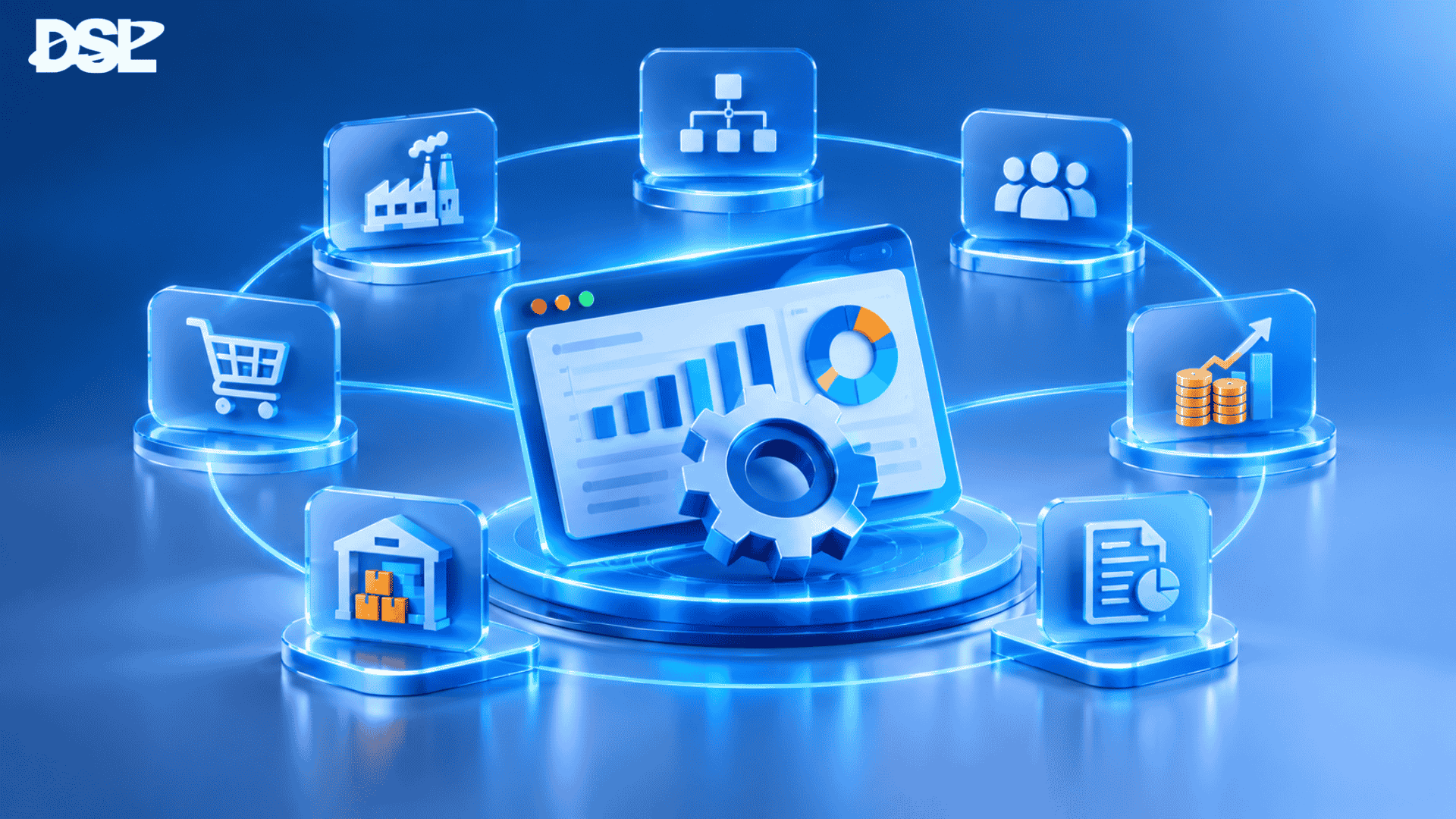
Every company has its own way of doing things. Production planning, bill of materials, warehouse management, and quality control may all be necessary for a manufacturing business. A retail company may prioritize point-of-sale operations, inventory management, customer management, and financial reporting.
Even if a basic ERP package includes the necessary components, it may not always meet the unique operating needs of every company.
Custom ERP software is useful in this situation.
The processes, operational structure, industry demands, and business goals of a company are taken into consideration while designing or configuring custom ERP software.
Some important advantages include:
1. Business-specific workflows: Depending on their needs, organizations might set up departmental workflows, operational procedures, and approval processes.
2. Flexible module selection: Companies can install the ERP modules they require and add more features as their business expands.
3. System integration: With the right connectors, custom ERP solutions can link to third-party services, payment systems, and other business platforms.
4. Scalable architecture: As a company grows, it can plan for more users, departments, locations, and operational needs.
5. Customized reporting: Dashboards and reports that accurately represent management's business priorities and performance metrics are available.
Organizations can investigate intelligent document processing, data analysis, workflow support, and other business-specific automation potential when AI capabilities are integrated into a custom ERP platform.
How Daffodil Software Ltd. Helps Businesses Modernize Their Operations
Choosing the correct technology partner is an essential step in ERP deployment and business automation. Organizations want solutions that meet their operating needs, integrate with existing systems, and enable future expansion.
Daffodil Software Ltd. offers corporate software solutions, ERP consulting and implementation, Odoo ERP customisation, custom software development, and custom AI application development to meet a variety of business needs.
With over 25 years of software development experience, Daffodil Software Ltd. specializes in creating technological solutions that assist enterprises in streamlining operations, improving operational visibility, and supporting digital transformation.
Smart Business 24: An Integrated ERP for Business Management
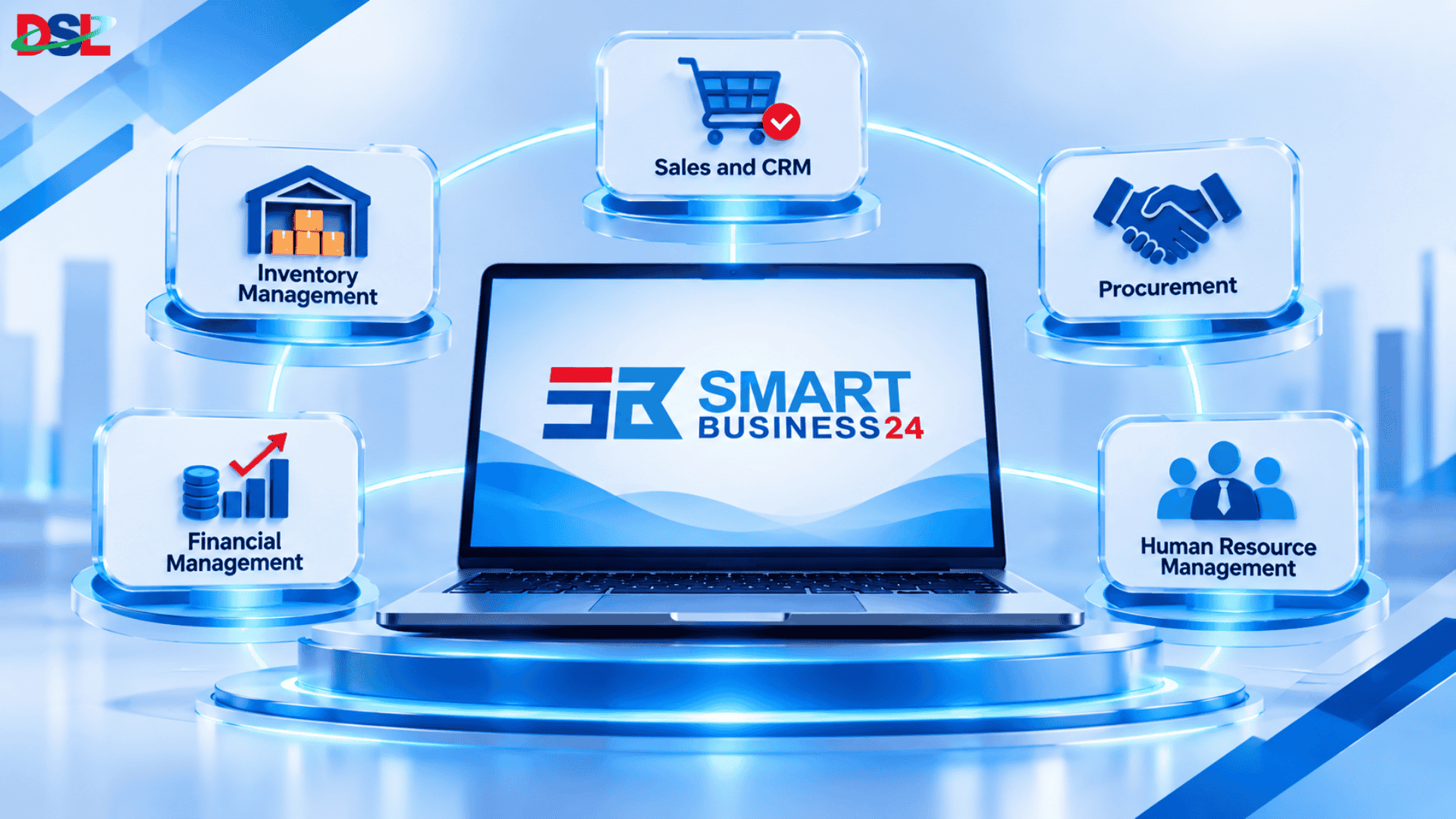
Smart Business 24 is an integrated ERP solution that combines key business functions on a single platform.
It connects several corporate functions, including:
Sales and CRM: Keep track of customer information, quotes, sales orders, deliveries, and relationships.
Procurement: Coordinate supplier management, purchase orders, and procurement activities.
Inventory Management: Keep track of stock levels, product movements, and warehouse activities.
Financial Management: Accounting, receivables, payables, budgeting, spending, and financial reporting are all aspects of financial management.
Human Resource Management: Organize recruitment, personnel records, attendance, leave, payroll, and performance evaluations.
Custom AI Application Development
ERP systems centralize business data, while custom AI applications can help organizations use that information more intelligently.
Daffodil Software Ltd. also provides custom AI development to build AI-powered applications around specific business requirements.
Depending on the use case, AI applications can support:
Intelligent workflow automation.
Document processing and information extraction.
AI-powered customer support.
Business data analysis.
Automated information classification.
AI-assisted reporting and insights.
CRM and customer engagement automation.
When connected with suitable enterprise systems, these capabilities can extend business automation beyond traditional rule-based workflows.
The appropriate solution depends on the organization's data quality, security requirements, existing infrastructure, and business objectives.
What Should Businesses Consider Before Implementing AI-Powered ERP?
Implementing AI-powered ERP automation demands careful planning. Businesses should assess their operational requirements before implementing technology or advanced automation.
Here are some key considerations:
1. Identify business requirements: Understand which operations cause operational issues and where ERP automation might add demonstrable value.
2. Evaluate existing systems: Examine existing software, databases, spreadsheets, and apps to determine integration needs.
3. Select the appropriate ERP modules: Choose modules based on actual business requirements, such as finance, sales, procurement, inventory, human resources, and manufacturing.
4. Prepare reliable business data: AI-generated insights are dependent on the quality, accuracy, and consistency of available data.
5. Plan your AI integration carefully: Rather than adopting AI without a clear business goal, identify particular use cases where AI may improve procedures.
6. Prioritize security and access control: Implement adequate security measures to protect critical financial, customer, employee, and operational information.
7. Train employees: Make sure they understand the system and how to use automated workflows and AI-assisted features properly.
8. Track performance: Evaluate implementation using relevant KPIs such as processing time, inventory correctness, reporting efficiency, and workflow completion rates.
A well-planned implementation enables firms to adopt technology in a disciplined manner and create long-term operational gains.
The Future of AI and ERP Automation in Businesses
Artificial intelligence and enterprise resource planning (ERP) technologies are becoming more significant in modern corporate administration. As businesses generate more operational data and manage increasingly connected workflows, the demand for integrated software and intelligent automation will increase.
Several advancements are influencing the future of AI-powered ERP:
Predictive Business Analytics: Using historical and current data to support demand planning, financial forecasting, and operational analysis.
AI-Powered Business Assistants: Helping employees retrieve information, understand reports, and complete selected business tasks.
Intelligent Document Processing: Extracting and organizing information from invoices, purchase orders, forms, and other business documents.
Connected Business Platforms: Integrating ERP, CRM, HRMS, e-commerce, and other enterprise applications.
Automated Decision Support: Providing relevant insights to help managers evaluate operational situations and make informed decisions.
However, AI will not be sufficient to ensure successful digital transformation. Businesses will also require a dependable ERP infrastructure, secure data management, proper integrations, employee training, and well-defined operational processes.
Organizations that combine these aspects can lay a more solid basis for long-term company growth.
Conclusion
AI-powered ERP automation will transform how businesses manage their operations by 2026. By combining centralized corporate administration with intelligent data analysis and workflow automation, firms may increase coordination, minimize repetitive processes, boost reporting, and make more informed decisions.
Integrated ERP systems serve as the foundation for networked corporate processes ranging from finance and inventory to sales, human resources, manufacturing, and customer management. AI capabilities can expand on this basis by assisting with forecasting, document processing, data analysis, and intelligent workflows.
For companies aiming to update their operations, choosing the correct ERP platform and implementation partner is critical.
Daffodil Software Ltd. helps businesses explore integrated software solutions that correspond with their operational needs and long-term goals through solutions like Smart Business 24, Odoo ERP customisation, and bespoke AI application development.